Edinburgh’s heroin crisis
Hide and SeekEdinburgh’s heroin crisis is both a public-health emergency and the background against which a suspected murder can pass as an ordinary overdose. The novel presents intravenous use, severe health risks and neglected housing as parts of the same urban reality, while Ronnie McGrath’s death shows how that reality can be exploited to disguise a deliberate killing.
A city under strain
When John Rebus arrives at Pilmuir, the housing estate appears to be reverting to wilderness. Its long grass and weeds, damaged playgrounds, boarded windows, broken fences and leaking drainpipes suggest sustained neglect rather than a temporary disruption. The nearby promise of a luxury development called Muir Village sharpens the contrast: the new marketing does not alter the place’s existing conditions, and Rebus sees the estate as a dumping ground. This setting does not by itself explain heroin dependence, but it locates the crisis amid physical deterioration and unequal investment, rather than in an abstract account of individual conduct.
The novel also makes the crisis visible through the people affected by it. In a discussion with Rebus, a doctor points to the scale of intravenous drug use in Edinburgh, estimating that the number of users likely runs into hundreds. He links that prevalence to the city’s grave AIDS burden. Superintendent Watson adds another measure of the problem: the Royal Infirmary has treated addicts as young as eleven or twelve. The age of those patients makes clear that the crisis reaches children as well as adults and cannot be contained within the story of a single death.
Overdose and medical risk
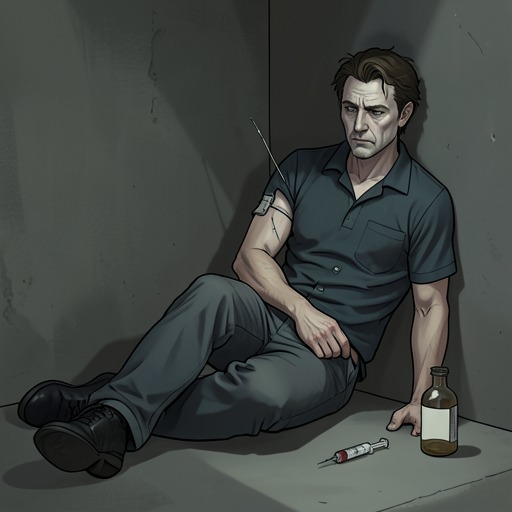
The initial medical assessment of Ronnie McGrath’s death seems to fit the familiar danger of heroin use. The doctor identifies an overdose and points out two small packets of powder: one appears to have been used, while another remains in Ronnie’s hand. That apparent explanation is complicated by bruising on the body, which the doctor says may have resulted from a heavy fall or physical confrontation. The finding does not establish what happened, but it prevents the overdose diagnosis from settling the question of whether another person was involved.
Later laboratory results make the supply itself central to the investigation. The heroin is reported to be 95 percent impure. Dr Enfield cannot yet identify the adulterant, but considers ground-up aspirin or rat poison possible and describes the substance as lethal. The doctor’s warning broadens the stakes beyond Ronnie: if more of the same material is circulating, other users may be at risk. The evidence establishes a dangerous sample and a plausible risk to others; it does not establish how widely that supply has spread.
Ronnie McGrath’s death and the appearance of an accident
Rebus’s review of the case exposes how readily the crisis can provide cover for violence. Ronnie’s body has been moved, and a packet of apparently good heroin has been left behind. Rebus considers whether the packet was meant to be tested, appear uncontaminated and encourage an official finding of death by misadventure. That possibility is not proof of a plan, but it explains why the distinction between an overdose and a staged death becomes difficult to resolve: heroin use makes an accidental death credible before the contradictory evidence is considered.
The circumstances Rebus assembles remain troubling and incomplete. He sees no suggestion that Ronnie did not inject himself, yet the account also indicates that Ronnie had been deprived of his supply despite heroin being readily available in the city. He then received heroin that was less than pure and took it despite knowing it was not good-quality supply. The clean packet and the poisoned one pull the apparent explanation in opposite directions: one could support the impression of an ordinary overdose, while the toxic material points to lethal danger. Rebus recognizes that his account contains conjecture and starts again rather than treating a possible reconstruction as established fact.
Complicity and the official response
The novel places the investigation beside a broader problem of refusing to ask where money comes from. One speaker tells Rebus that people do not want to know the source of the money, because knowing would make them accessories; the speaker says that when an explanation was offered, he chose not to hear it. The exchange does not specify a complete financial chain, but it gives the crisis a social dimension: ignorance can be a chosen position, and avoiding knowledge may protect people from responsibility while leaving harmful activity undisturbed.
Superintendent Watson responds to the city’s drug problem by announcing an anti-drugs campaign combining public awareness with funding for discreet information. He says he has backing and money, including a commitment of fifty thousand pounds from a group of local businessmen. His proposal makes institutional concern concrete, but it also sits beside the investigative uncertainty surrounding Ronnie’s death. The campaign addresses a public emergency at the level of information and prevention; the case requires determining whether a particular overdose was deliberately caused and staged.
Narrative significance
By setting a possible murder within a real and widespread overdose crisis, the novel makes the crisis more than background. It supplies a plausible public explanation for Ronnie’s death, raises the possibility that dangerous heroin may harm other users, and forces Rebus to separate evidence from assumptions. At the same time, the contrast between Pilmuir’s deterioration and the nearby luxury development gives the crisis a material setting: the city’s advertised promise and the conditions faced by vulnerable residents coexist only a short distance apart. The result is a portrait of harm that is personal in its consequences but not confined to personal choice; the investigation turns on a contaminated supply, concealed circumstances and the limits of what people or institutions are willing to know.